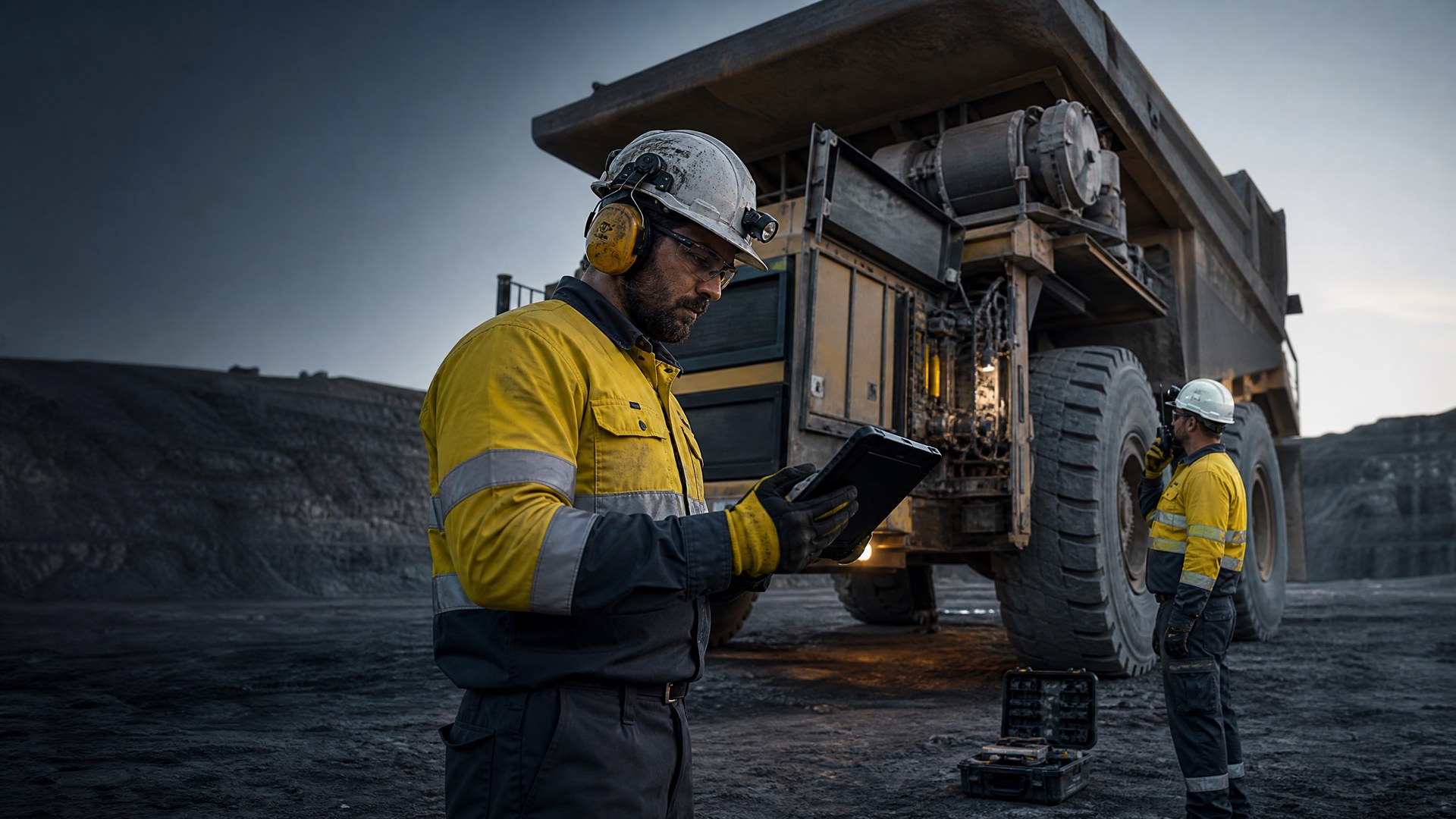
Stop hoarding data and start connecting it. The liability in your servers can become your greatest competitive asset. The Enterprise Knowledge Graph is how you get there.
Your Data Is a Liability, Not an Asset. Here’s How to Fix It.
Heavy industry is drowning in data. We have gigabytes of telemetry from our fleets, years of maintenance logs in the CMMS, and endless spreadsheets tracking parts, people, and project timelines. We’ve been told for years that “data is the new oil.” But for most organisations, it’s not. It’s a liability.
Data that is siloed, unstructured, and disconnected from the assets and people who do the work isn’t an asset. It’s a cost center. You pay to store it, you pay to secure it, and you risk making bad decisions based on an incomplete picture. The solution isn’t more data; it’s more connections. The solution is an Enterprise Knowledge Graph.
What is an Enterprise Knowledge Graph?
Forget the complex academic definitions. At its core, a knowledge graph is a system for connecting information, just like your brain does. A traditional database is like a spreadsheet—it stores information in rigid rows and columns. A knowledge graph is like a network—it stores information as a collection of entities (nodes) and the relationships between them (edges).
A database tells you what happened. A knowledge graph tells you why it happened and who knows how to fix it.
This shift from storing data to connecting it unlocks a fundamentally new level of intelligence. You can move from simple queries to asking complex, multi-dimensional questions that mirror how the real world works.
| Aspect | Traditional Database (e.g., CMMS) | Enterprise Knowledge Graph |
|---|---|---|
| Structure | Rigid tables, rows, and columns. | Flexible nodes (entities) and edges (relationships). |
| Example Query | "Show me all maintenance jobs for Excavator #123." | "Show me all operators who have fixed a hydraulic leak on Excavator #123 in the last 6 months, what parts they used, and the mean-time-to-repair for each job." |
| Primary Value | Data storage and retrieval. | Insight generation and pattern discovery. |
The ROI in Mining and Construction
This isn’t just a theoretical advantage. Connecting data delivers a hard-edged ROI by solving expensive, recurring problems that are invisible when your data lives in silos.
Mining Scenario: The Phantom Fault
A major mine site is experiencing recurring hydraulic failures on its haul trucks, but only at one of its three pits. The maintenance logs in the CMMS show the failures, but not the pattern. The procurement ERP shows that different hydraulic fluid batches were sent to each pit. The telemetry data shows higher operating temperatures at the pit with the failures. A knowledge graph connects these three siloed datasets, revealing the root cause: a specific batch of hydraulic fluid is failing prematurely, but only in high-temperature applications. The company can now isolate the bad batch, saving hundreds of thousands in unplanned downtime and component damage.
Construction Scenario: De-Risking a Complex Bid
A large contractor is bidding on a critical infrastructure project involving challenging geotechnical conditions. The bid is high-stakes and low-margin. Using their Enterprise Knowledge Graph, the bid team can instantly identify: 1) The two supervisors with the most hands-on experience with the specific soil type. 2) The crew that has the best safety and productivity record on similar projects. 3) The most common equipment failures and delays from their last three comparable jobs. This allows them to create a more accurate, lower-risk bid, price it more competitively, and execute more effectively, protecting their margin.
How to Build Your Knowledge Graph, Today
This doesn’t require a multi-year, eight-figure IT transformation. You can start building a powerful knowledge graph from the ground up by focusing on the most valuable, and most overlooked, data source: your frontline teams.
The tribal knowledge in the heads of your operators, fitters, and supervisors is the glue that connects all your formal data. Capturing it is the first step.
- Capture Frontline Knowledge: Give your crews a simple, mobile-first way to document faults, fixes, and observations as they happen. This isn’t about filling out complex forms; it’s about capturing a photo, a voice note, or a quick text description of the problem and solution.
- Connect it to the Asset: A platform like TORQN automatically links every piece of frontline knowledge to the specific asset (e.g., CAT 793F, Serial #XYZ), component, and person. This creates the foundational layer of your knowledge graph.
- Query for Insights: Once the knowledge is captured and connected, you can start asking the high-value questions that were previously unanswerable. You can spot patterns, identify your in-house experts, and share proven solutions across your entire enterprise.
Stop hoarding data and start connecting it. The liability in your servers can become your greatest competitive asset. The Enterprise Knowledge Graph is how you get there.