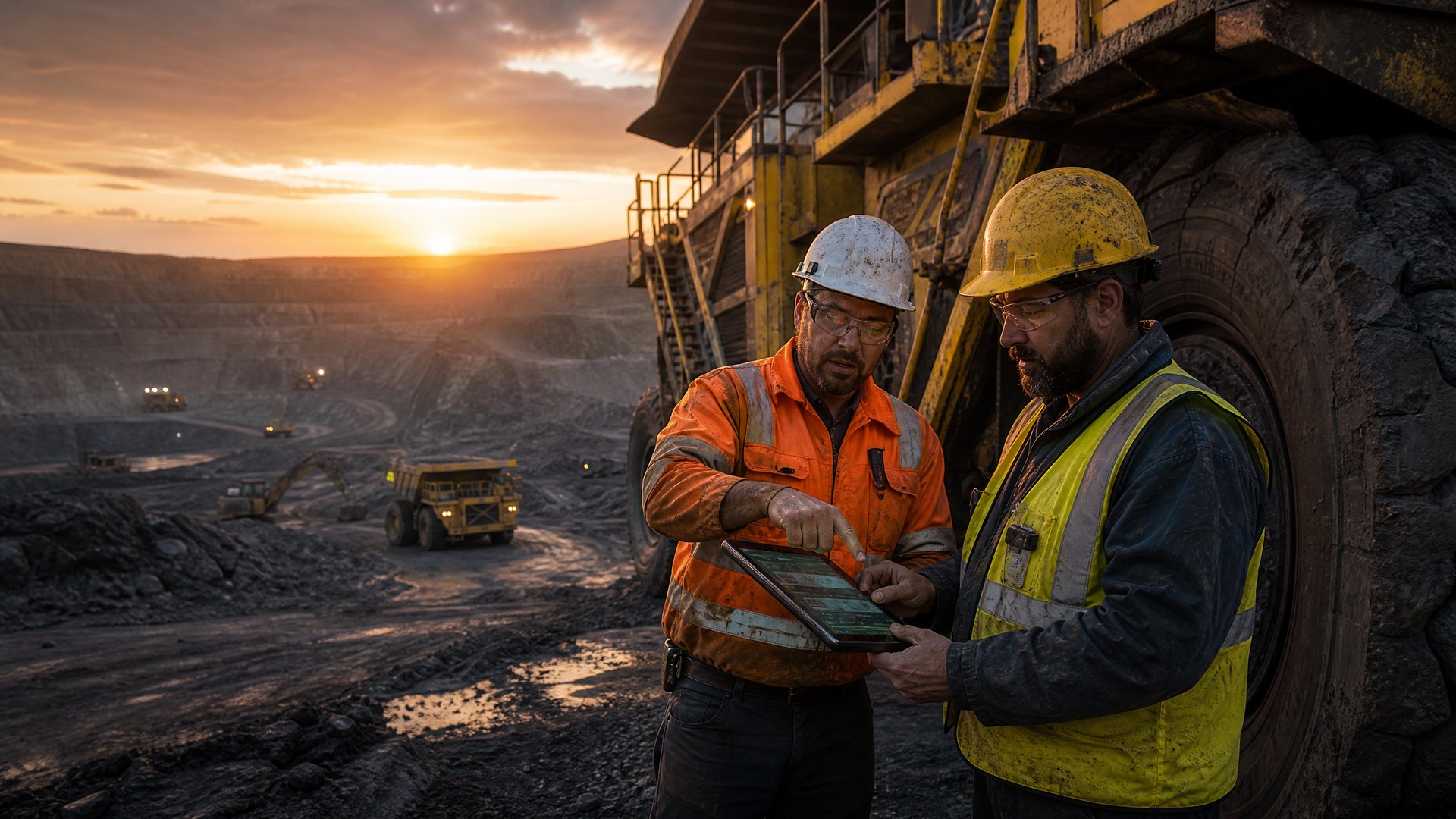
Your best people are walking out the door with knowledge worth millions. Here's the real cost of uncaptured expertise in mining and construction and, how to stop the bleeding.
The Million-Dollar Walkout: Why Uncaptured Knowledge Is Costing You More Than You Think
Your most experienced mechanic is about to retire. He’s been with you for 30 years. He knows every quirk of your oldest, most critical assets. He can diagnose a fault on a haul truck by the sound it makes and has saved the company millions in downtime with fixes that aren’t in any manual. When he walks out the door, he’s not just taking his toolbox. He’s taking a library of unwritten knowledge that is, for all practical purposes, a core business asset.
In industries like mining and construction, this isn’t a sentimental problem. It’s a financial one. The failure to systematically capture and transfer frontline expertise is a silent, slow-moving crisis. When a key team member leaves, the cost isn’t just their salary; it’s a cascade of direct and indirect expenses that hit your profit and loss statement hard.
The True Cost of a Lost Expert
Most companies drastically underestimate the cost of employee turnover. They see the recruitment fee and the new salary, but that’s just the tip of the iceberg. The real costs are hidden in the operational details. A 2019 report by the Society for Human Resource Management (SHRM) noted that it can cost six to nine months of an employee’s salary to replace them. For a senior technician earning $120,000, that’s a $60,000 to $90,000 hit before the new hire even becomes fully productive.
When expertise walks out the door, it leaves a vacuum. The work doesn’t stop, but the institutional memory required to do it efficiently and safely is gone. The cost of that vacuum is paid in lost time, repeated mistakes, and missed opportunities.
Let's break down the real costs when a veteran leaves and their knowledge is not captured:
| Cost Category | Description | Example Impact (Mining & Construction) |
|---|---|---|
| Recruitment & Hiring | Advertising, recruiter fees, interview time for multiple managers. | $20,000 - $40,000 for a specialized role. |
| Onboarding & Training | Formal training, supervisor time, HR processing, initial tooling. | Weeks of non-productive time for the new hire and their mentor. |
| Lost Productivity | It can take a new hire 1-2 years to reach the productivity of an experienced predecessor. | Slower diagnostics, longer repair times, delayed project milestones. |
| Safety & Rework | New hires are statistically more likely to make errors, some with serious safety or quality implications. | A botched repair leading to secondary equipment failure; a misread plan causing costly rework. |
From Abstract Asset to Concrete Cost: Two Scenarios
This isn’t theoretical. It happens on sites every day.
Mining Scenario: The Unwritten Transmission Fix
A remote iron ore mine has a fleet of aging haul trucks. There’s a specific transmission fault that occurs in extreme heat that isn’t covered by the OEM manual. One senior mechanic, Dave, figured out a workaround years ago involving a non-standard sensor adjustment. It’s a 30-minute fix that prevents a full transmission swap. Dave retires. Six months later, the fault appears on three trucks. The new mechanics, following the book, can’t solve it. The trucks are down for a week waiting for a specialist, resulting in over $1 million in lost production.
Construction Scenario: The Concrete Pour That Cracked
A veteran project superintendent, Maria, is overseeing a high-rise build. She knows from 20 years of experience that for a specific type of suspended slab, the standard concrete mix needs a specific additive if the overnight temperature is forecast to drop below 5°C, even though the spec sheet doesn’t call for it. Maria moves to another project. Her replacement, following the specs to the letter, orders the standard mix. A cold snap hits, and micro-cracks form across the slab, requiring a multi-week, six-figure remediation project.
Stop the Bleeding: A New Approach to Knowledge
The traditional exit interview is a post-mortem. The knowledge is already gone. The solution is to treat knowledge as a living asset that is continuously captured, validated, and shared as part of your daily operations. It’s about building a system where every problem solved on the front line becomes a permanent part of your company’s institutional memory.
Platforms like TORQN are designed for this exact purpose. They provide a framework for your team to capture solutions in the moment—with video, photos, and text—and tie that knowledge directly to the asset, location, or task it relates to. When a mechanic like Dave performs his unique fix, he can record a 60-second video on his phone, tag it to the haul truck model and fault code, and it instantly becomes a searchable, permanent solution for the entire organization.
Your Knowledge Is a Compounding Asset
Every piece of knowledge you capture doesn’t just prevent a future problem. It becomes a building block. The more you capture, the smarter your organization gets. New hires can search for solutions instead of interrupting senior staff. Trends in repairs can be spotted before they become fleet-wide failures. Best practices from one site can be instantly shared with another.
Don’t wait for the next retirement party to think about the knowledge walking out the door. Start capturing it today. The cost of inaction, as measured in downtime, rework, and safety incidents, is far greater than the investment in a system to retain your most valuable asset: your team’s hard-won expertise.